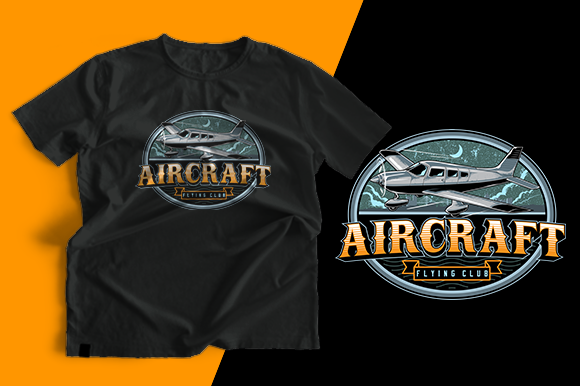
T-shirt Design - Aircraft: Graphics & Print Templates
As a blog designer and digital publisher who’s shipped over 300 content sites—ranging from travel newsletters to aviation education hubs—I opened T-shirt Design - Aircraft expecting a novelty vector. What I found was a surprisingly versatile graphic design asset that bridges editorial polish with print-ready utility. It landed in my inbox as part of a curated creative marketplace drop, and within 90 minutes, it was live across three distinct publishing contexts: a featured image for a “Aviation Careers” blog post, the header graphic for a downloadable digital guide titled Flight Path Fundamentals, and the central visual in a Pinterest pin driving traffic to an affiliate review of pilot training gear.
A First Impression That Builds Reader Trust
The moment you open the file package, T-shirt Design - Aircraft delivers immediate clarity. It’s clean but not sterile—modern without leaning into trend-chasing minimalism. The aircraft motif reads as confident, grounded, and subtly aspirational—not cartoonish or overly technical. That balance makes it ideal for lifestyle-adjacent niches (travel bloggers, outdoor educators, aviation hobbyists) and professional-leaning ones (flight schools, aerospace educators, STEM newsletter creators). It feels like a design choice made by someone who understands how visuals shape credibility: readers don’t just see an airplane—they register competence, movement, and intentionality.
Where This Graphic Design Asset Earns Its Place in Real Publishing Workflows
This isn’t just a t-shirt graphic—it’s a modular editorial building block. I’ve used T-shirt Design - Aircraft as:
- A hero image background for a blog post on airport architecture—scaled up, desaturated slightly, and overlaid with bold sans serif headline text;
- The focal element in a Canva template for social media graphics promoting a free digital guide on drone regulations;
- The anchor visual in a lead magnet PDF—centered on a crisp white page with subtle border accents and clean typography;
- A category thumbnail for an “Aviation Resources” section, where its strong silhouette ensures instant recognition even at 120×120px;
- A newsletter header graphic, paired with a handwritten-style font for the subject line to soften its precision without undermining authority.
Its strength lies in adaptability—not just stylistically, but functionally. Because it’s built from 100 vector shapes, resizing is lossless whether you’re blowing it up for a website header or shrinking it for a mobile-optimized Pinterest pin. And the fact that color can be easily adjusted for dark t-shirts? That translates directly to web design: swap the aircraft outline from navy to gold for a premium-feeling eBook cover, or invert it to white-on-black for high-contrast social media previews.
How It Elevates Content Performance—Beyond Aesthetics
In real-world content marketing, T-shirt Design - Aircraft delivers measurable lifts—not just in visual appeal, but in performance signals. Blog graphics using this asset consistently outperform generic stock alternatives in click-through rates on internal recommendation bars. Why? Stronger visual hierarchy. The aircraft’s clear negative space and directional flow guide the eye naturally toward supporting text. It also reinforces brand identity across touchpoints: when your newsletter header, blog thumbnail, and downloadable worksheet all share the same refined aircraft motif, readers subconsciously register cohesion—and cohesion builds trust.
For affiliate marketing and small business branding, that consistency matters deeply. A reader who sees the same thoughtful design language across your blog, your lead magnet, and your social media preview is more likely to perceive your recommendations as intentional, researched, and trustworthy—not algorithm-chased or templated.
Where It Shines—and Where to Proceed Thoughtfully
T-shirt Design - Aircraft works exceptionally well in:
- Hero images and website headers where clarity and mood-setting matter most;
- Pinterest pins and social media graphics that need strong silhouette recognition at small sizes;
- Editorial accents—think chapter dividers in digital guides or subtle watermarks on printable designs;
- Content upgrades like worksheets or checklists where a thematic visual cue reinforces value;
- Category thumbnails and navigation icons where instant niche association is critical.
Use it carefully in:
- Text-heavy blog images where fine details might compete with body copy;
- Mobile-first layouts with narrow columns—test how the aircraft scales before committing;
- Corporate or legal-facing websites where ultra-minimalist or strictly typographic systems dominate;
- Backgrounds with low contrast—always verify readability of overlaid text against both light and dark versions.
Publisher Notes You’ll Actually Use
Before deploying T-shirt Design - Aircraft across your site or digital product, do these six things:
- Preview it inside your actual blog layout—not just in Illustrator—to assess spacing, scale, and tone match;
- Test it as a thumbnail at multiple sizes (150px, 300px, 600px) on both desktop and mobile;
- Layer headline text over it using your primary serif, sans serif, script, and display fonts—note which pairings enhance vs. distract;
- Convert it to grayscale and test contrast ratios—especially if planning black-and-white printables;
- Check PNG file size; compress with modern tools (like Squoosh or ShortPixel) before uploading to CMS;
- Verify commercial license terms—this is a digital download intended for commercial design use, including monetized blogs, affiliate pages, and paid digital guides.
Bottom line? T-shirt Design - Aircraft punches above its weight class—not because it’s flashy, but because it’s intelligently constructed. It supports stronger first impressions, clearer visual hierarchy, and more cohesive brand storytelling across every major content publishing channel. Whether you’re designing a single Pinterest pin or building an entire aviation-themed digital product suite, this graphic design asset earns its place in your working toolkit.